Your data stays yours
Your data sits in SQL Server in a documented schema, and you can export all of it at any time at no charge. Migrating in or out is a database job with a documented procedure, and we will walk your team through it either way.

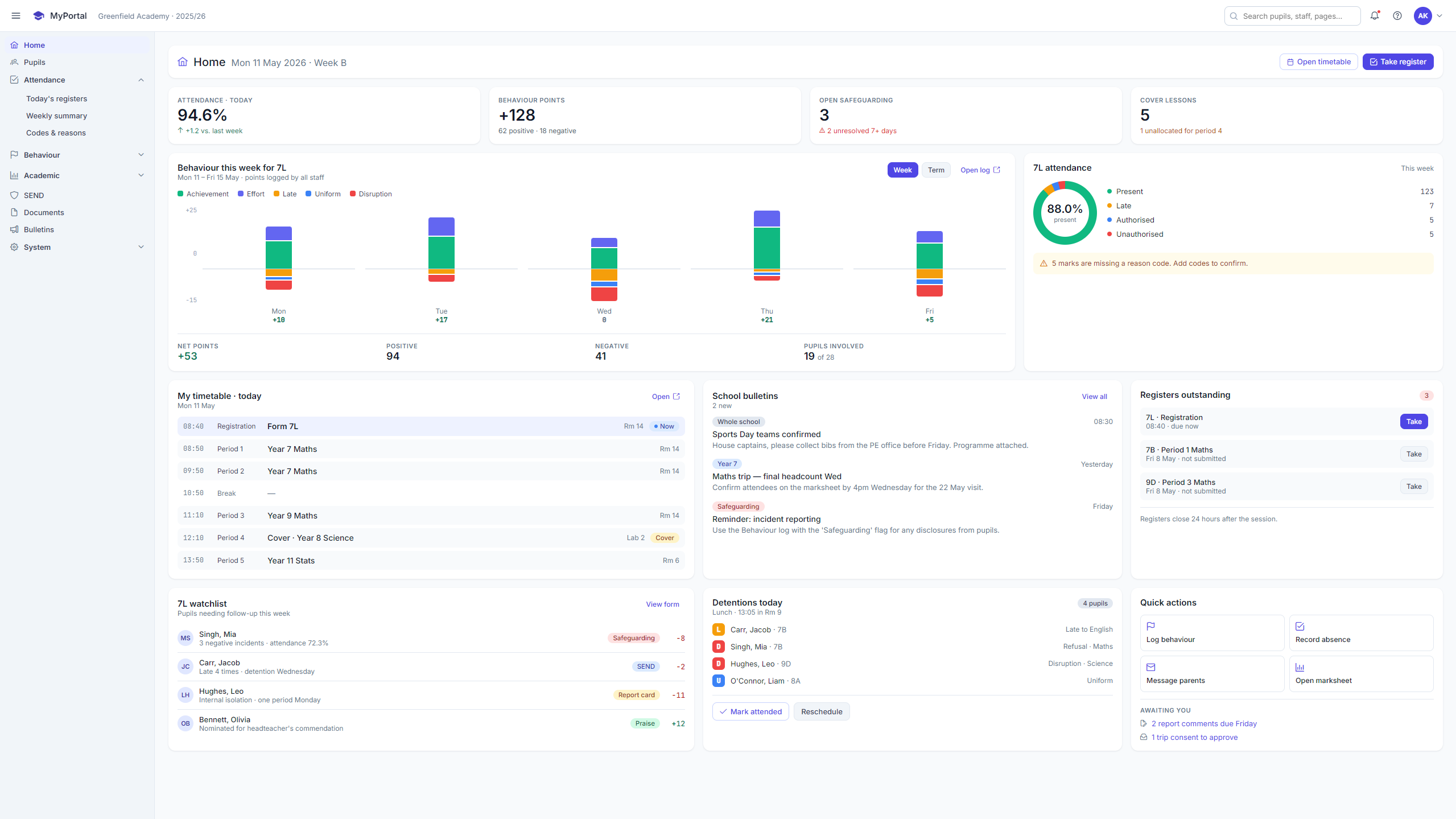
MyPortal is an information management system for UK schools — attendance, behaviour, exams, timetabling and reporting. One pupil record, one permission model, one audit trail, hosted wherever your data belongs.
Why MyPortal
That is a good reason to be careful about how it works.
Your data sits in SQL Server in a documented schema, and you can export all of it at any time at no charge. Migrating in or out is a database job with a documented procedure, and we will walk your team through it either way.
An MIS holds safeguarding notes, SEND plans and behaviour records. Access control and auditing are enforced centrally on every request, so the decision is made server-side each time rather than re-implemented module by module.
Run MyPortal in our UK cloud, or deploy the same build inside your own tenancy so the data never leaves your infrastructure. Where it lives is a decision for your school and its DPO, and both deployments are supported the same way.
Modules
Each module stands on its own, and every one of them shares a single permission model, a single audit trail, and a single source of truth.
Statutory session and lesson marks, registers, and absence follow-up.
Incidents, sanctions, achievements, and the reporting behind them.
Entries, seating, access arrangements, and results.
Marksheets, grade sets, and progress tracking across a cohort.
Subjects, classes, teaching groups, and the school timetable.
Registrations, contacts, addresses, and the full pupil record.
Employment records, roles, and the permissions that follow them.
Provisions, plans, and the review cycle around them.
Report cycles, comment banks, and published reports.
Applications, offers, and the route from applicant to on-roll.
Attachments and file storage bound to the records they belong to.
School configuration, academic years, terms, and system settings.
Who it is for
Staff, students and parents are served by the same system through role-based routing, so all three views read from one pupil record and stay in step by design.
Teachers, tutors, pastoral leads and administrators each get a view built around what their role actually does, with permissions to match.
Timetable, assessment, behaviour points and documents, in a view appropriate to their age and to what the school chooses to share.
Attendance, reports and school communication, without a separate app to buy and a separate database to keep in sync.
Architecture
None of this is exotic. A school IT team should be able to read the stack, host it, back it up, and restore it without learning a new ecosystem first.
How it fits togetherWhere we are
Core services and the foundational modules are in place, and the rest is being built out. We would rather tell you that now than sell you a timetable we cannot meet. If you are planning a change of MIS and want to shape one while it is still being built, this is the point at which that is worth doing.
Moving across
Every school we speak to has been burned by a data migration, or has heard from someone who was. So we treat it as a project with a named owner and a rehearsal.
Tell us what you run now, your roll, and when your current contract ends. We will be straight with you about whether MyPortal fits yet.
We stand up a private instance so your team can work through the modules that matter to you, hands on and at their own pace.
Your real data, extracted from your current MIS and loaded into that instance, so mismatches surface now rather than in September.
A scheduled switch at a point in the calendar that suits the school, with the old system kept readable behind you.
What that looks like in practice depends on what you are running now — tell us and we will be specific.
Timetabling edge cases, a decade of historic attendance, a federation with shared staff — the awkward requirements are the interesting ones. Tell us what your school actually needs and we will tell you honestly whether MyPortal does it yet.